sperm whale
Sperm whales appear in Jules Verne's narrative as a fearsome species of cetacean, described by Captain Nemo as "dreadful animals" that deserve extermination. They are depicted as cruel, destructive beasts, equipped with enormous heads that occupy about a third of their body length, which can exceed twenty-five meters. Their most notable feature is their formidable armament: twenty-five huge teeth, each twenty centimeters high, cylindrical with conical summits, and weighing two pounds apiece. These teeth make them far more dangerous than baleen whales, which possess only whalebone. The sperm whale is also described as an awkward, poorly constructed animal, more tadpole than fish, with a defect on the left side of its frame and good eyesight only in its right eye. Within its enormous head, cavities separated by cartilage hold 300 to 400 kilograms of the valuable oil known as spermaceti.
The Mass Slaughter of Sperm Whales
The most significant encounter with sperm whales occurs on March 14, when the Nautilus falls in with a herd of baleen whales. Captain Nemo points out a group of sperm whales eight miles to leeward, describing them as cruel, destructive beasts that deserve to be exterminated. He declares that the Nautilus, armed with a steel spur, will suffice to disperse them. The Nautilus proceeds to midwater and maneuvers to cut into the herd of long-skulled predators. The battle is described as a Homeric slaughter, lasting an hour. The Nautilus, wielded by Captain Nemo like a fearsome harpoon, runs the sperm whales clean through, leaving behind two squirming animal halves. The ship is untroubled by their daunting tail strokes or collisions, and it skewers them from every direction and at any speed with its dreadful spur. The sea becomes covered with mutilated corpses, and the waves are dyed red over an area of several miles. The Nautilus floats in the middle of a sea of blood.
Ned Land's Reaction and the Ethical Divide
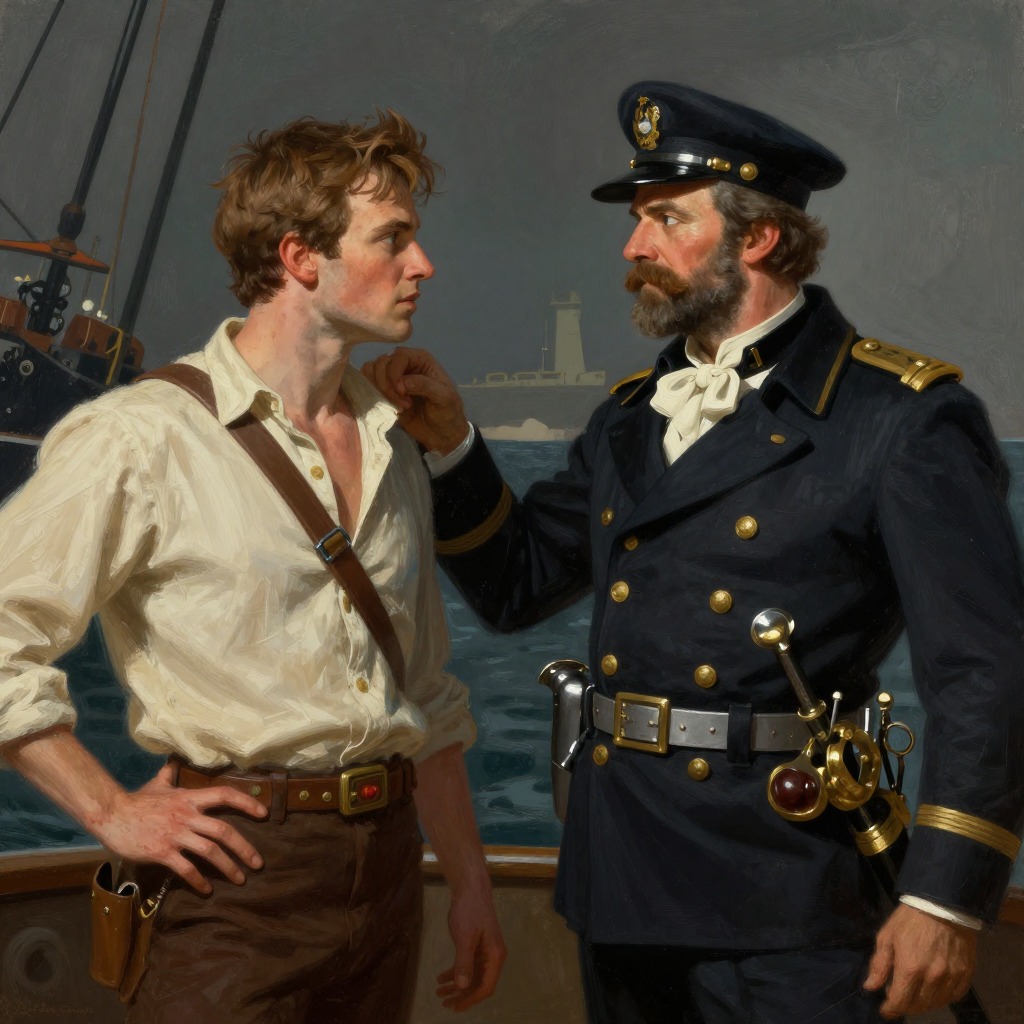
Ned Land, the Canadian harpooner, initially watches the slaughter with growing enthusiasm and even ends up applauding. However, after the carnage subsides, his enthusiasm wanes. He tells Captain Nemo, "It's a dreadful sight for sure. But I'm a hunter not a butcher, and this is plain butchery." Captain Nemo replies, "It was a slaughter of destructive animals, and the Nautilus is no butcher knife." Ned Land insists, "I prefer my harpoon." This exchange highlights a fundamental ethical divide between the two men: Ned Land sees the killing as a violation of his hunter's code, while Captain Nemo views it as a necessary act of extermination against a species he considers purely destructive, describing them as "merely mouth and teeth."
The Sperm Whale as a Symbol of Destructive Nature
Captain Nemo's justification for the slaughter is rooted in his view of sperm whales as natural enemies of the more harmless baleen whales. He argues that baleen whales have enough natural enemies without counting man, and that the sperm whales are about to attack the herd. The Nautilus intervenes to rescue the baleen whales. This event serves to illustrate Captain Nemo's complex moral code: he forbids the hunting of baleen whales for sport, calling it a "reprehensible offense," yet he himself engages in a mass slaughter of sperm whales, which he deems deserving of extermination. The sperm whale thus becomes a symbol of a destructive, predatory force that Captain Nemo feels justified in annihilating, foreshadowing his later, far more terrible act of vengeance against a warship. The episode also deepens the tension between Ned Land and Captain Nemo, as the harpooner's professional pride and ethical sensibilities are offended by the captain's cold, mechanical butchery.